

The Wigtown Emporium
1890s J B Schall 5 string open back banjo
1890s J B Schall 5 string open back banjo
Couldn't load pickup availability
Chicago based J B Schall 5 string open back banjo circa 1890. 12" pot, 16 frets, 28" scale length, superb condition for its age, plays beautifully with that rich deep 12 inch sound.
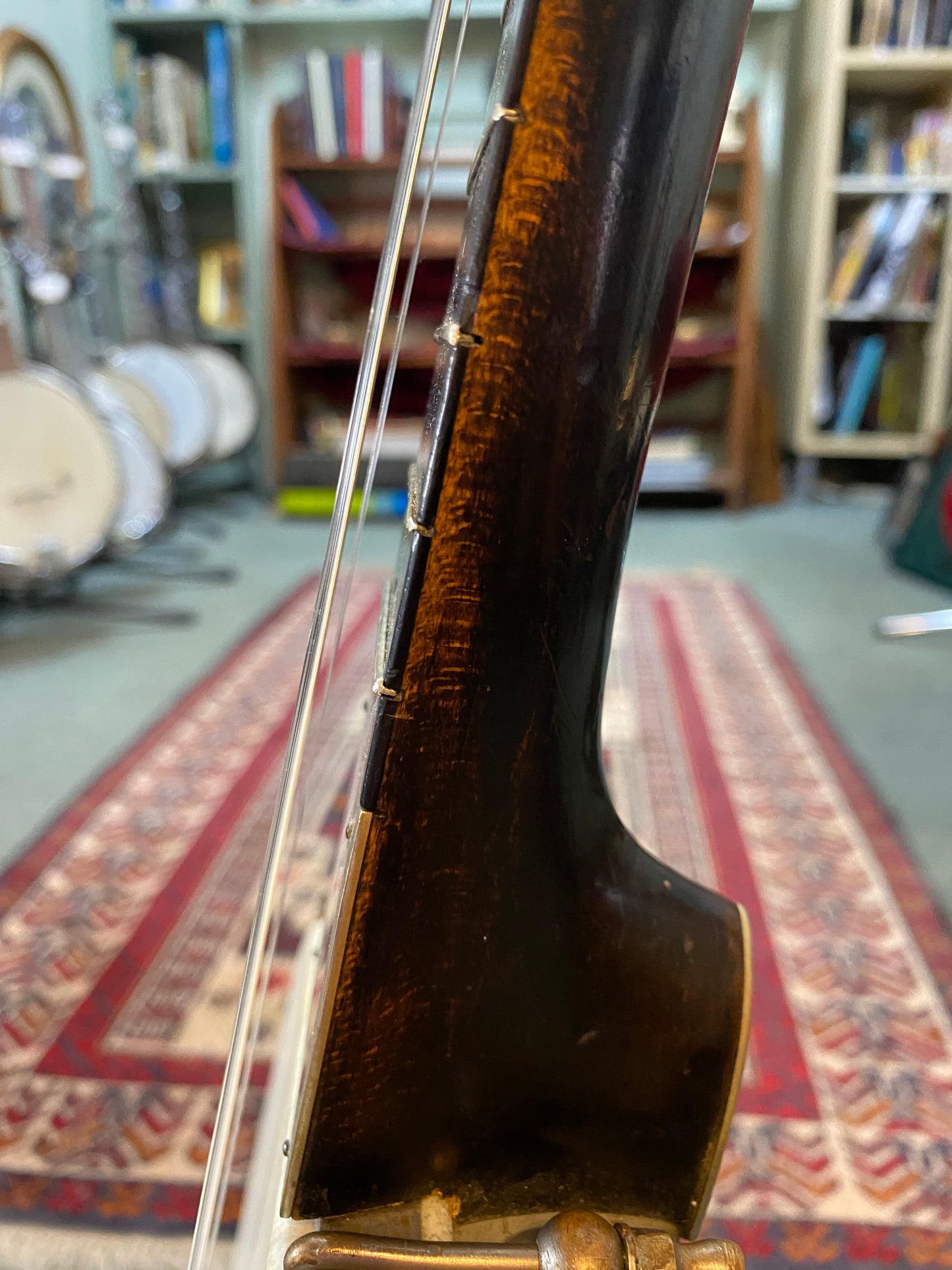
Pot and neck are unbranded but this was common for Schall as he made for other makers as well as his own brand instruments. This banjo includes his trademark use of engraved silver in this case on the peg head. Another typical feature of his banjos is the use of a metal plate in place of the scoop. Finally, there is the decorative heel plate commonly found on Chicago based banjos and ball hardware on the spun over rim.
Condition: Overall excellent for its age. Neck is straight (no bow or twist) and as with most of these Vintage banjos is in line with the head therefore the action is high. This was originally to accommodate gut strings which vibrated more and required additional space. The neck relief has not been altered since it was first built. Small split in the dowel stick near the tailpiece but not structurally significant. Vellum is not original but is of good quality. Original hardware all present and has not been overly cleaned thereby keeping that beautiful vintage patina.
History:
J. B. Schall was born in St. Joseph, Mo., U.S.A., in 1852 and in his younger days worked as a stone mason. He became interested in wood working and mechanics of various kinds and became skilled in the use of tools pertaining to several trades.
As a hobby he played the banjo (extremely well, say critics of the period) and while still a young man joined a minstrel troupe with which he toured extensively for several years. His acquaintanceship with minstrel performers and theatrical people generally, coupled with the growing demand for banjos, induced him to open a banjo factory in Chicago in 1870. He became one of the greatest banjo makers in America (as far as quality was concerned) and it is said the reason for the superior excellence of Schall's banjos was due to the fact that he was an exceptionally skilled mechanic who worked at the bench beside his five employees. His banjos became justly celebrated and were in demand among all the leading banjoists of his day.
In 1881 Clarence L. Partee became manager of' his offices and showrooms and, in addition, taught the banjo "by note".
About 1895 Schall suffered a stroke, and he had to close down his business. He eventually recovered but for several years suffered from chronic rheumatism and partial paralysis. In 1905 his health improved, and he opened a small banjo shop (over which he lived by himself) and started to make banjos by himself for professional players, although orders were scarce. He did make a banjo for Burt Earle early in 1907.
He died in dramatic circumstances.
He had just completed two banjos for an act appearing at the Olympic Theatre in Chicago and the players invited him to hear their performance. Occupying a front seat in the balcony, Schall was listening to the tone of the instruments he had made when suddenly he rose in his seat with a choking cry, swayed for a moment as if he would topple over the balcony rail into the crowded stalls, and fell to the floor. Ushers and attendants rushed to his aid and carried him to the foyer where they attempted to revive him. The act on the stage continued, unaware that Mr. Schall was dying behind the tier of balcony seats.
Once he partially gained consciousness. He opened his eyes and murmured: "I think I can go home now". Just then the players on the stage burst into a popular song of the day and as the last bars ceased and the audience burst into applause, J. B. Schall breathed his last. BMG Vol. LXX No. 815 MARCH 1973, P187